
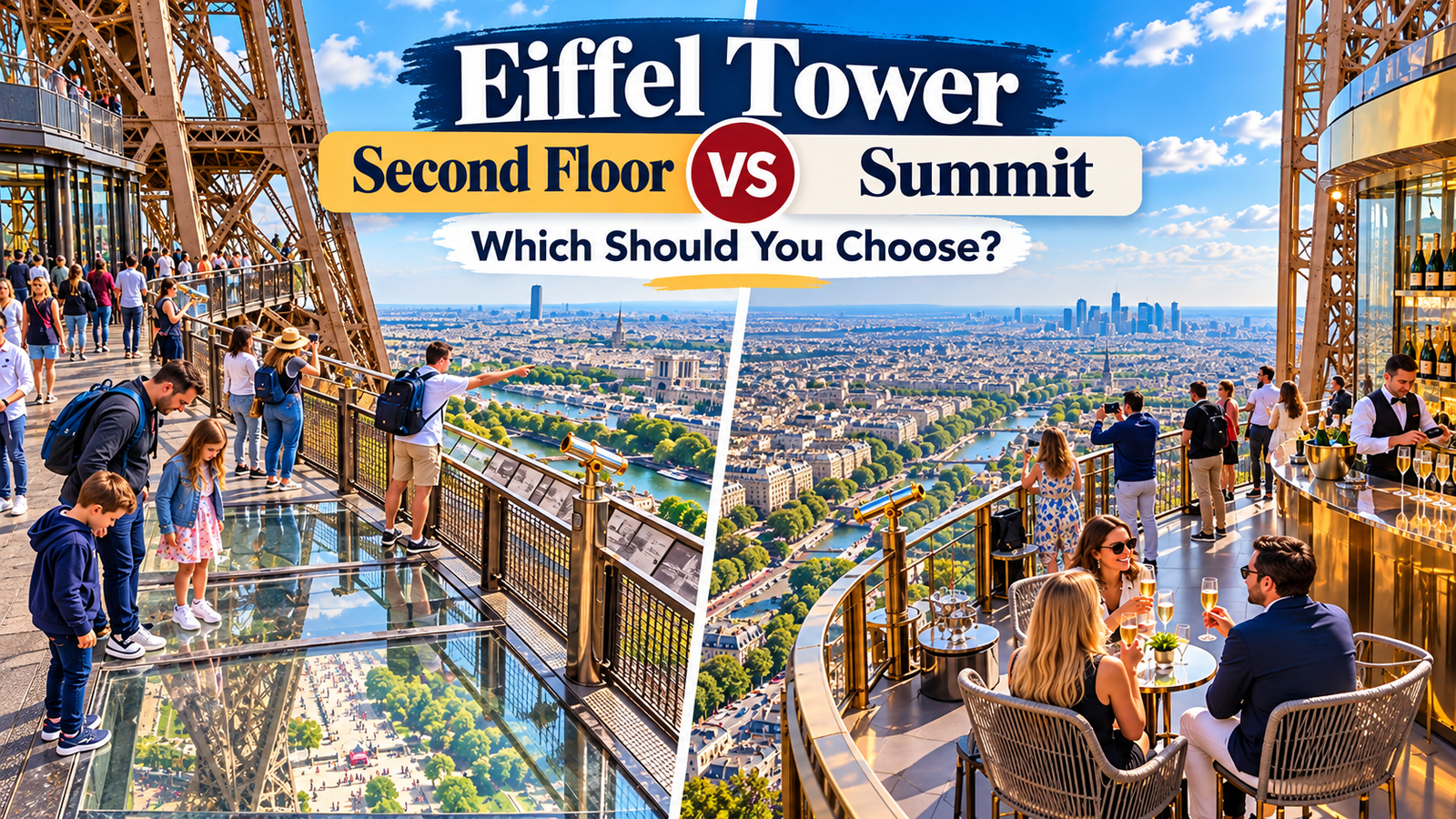
Planning a trip to Paris almost always includes one non-negotiable item: visiting the Eiffel Tower. But once you start researching tickets, you hit a fork in the road. Should you book a ticket to the second floor, or go all the way to the summit?
It’s one of the most common questions travelers ask, and the answer isn’t as obvious as “higher is better.” The second floor and the summit offer fundamentally different experiences — different views, different prices, different queues, and different bragging rights. This guide breaks down every detail so you can book with confidence.
Understanding the Eiffel Tower’s Three Levels
Before diving into the comparison, it helps to understand what each level actually offers. The Eiffel Tower has three visitable levels, and each one delivers a distinct experience.
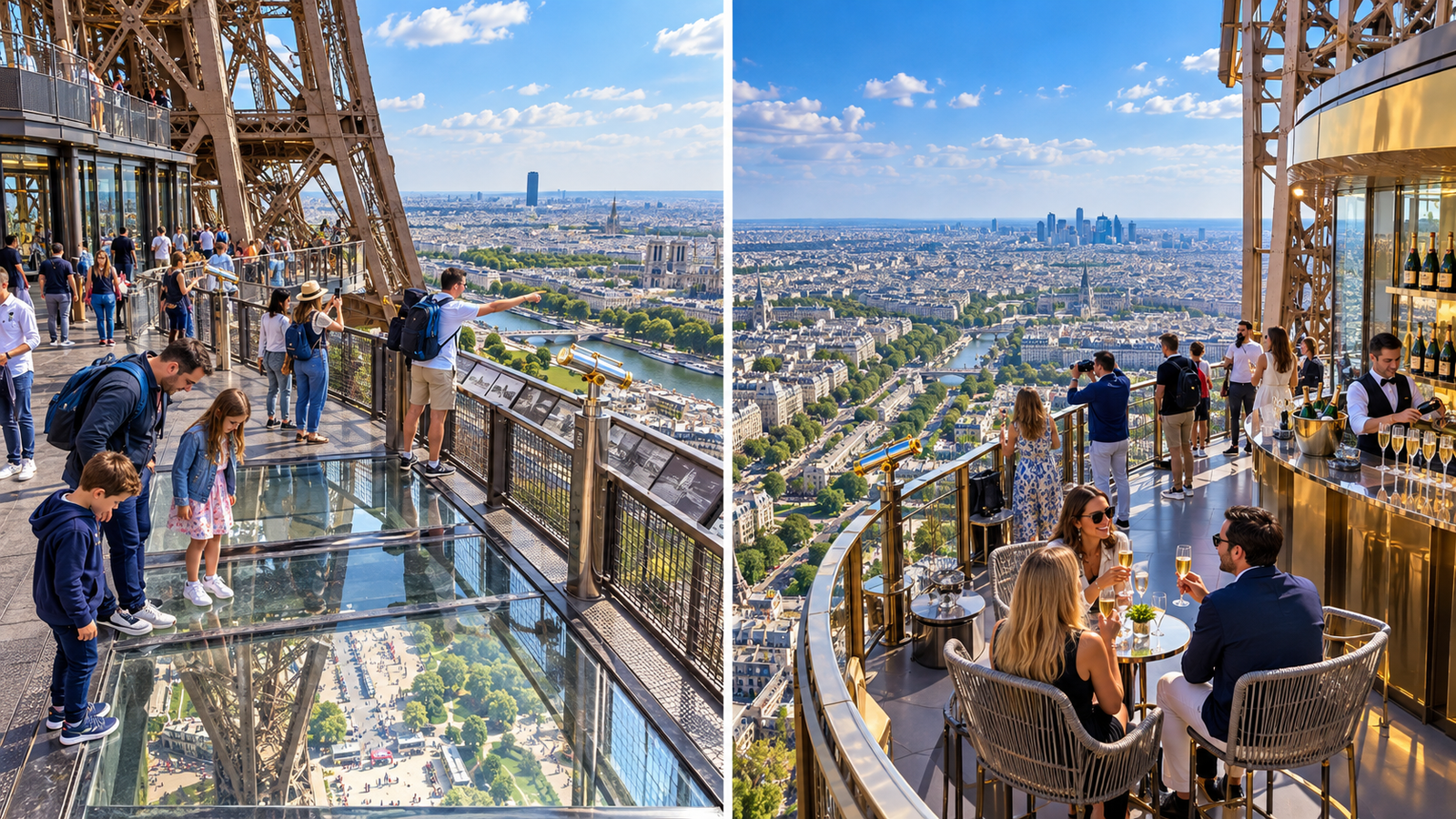
The First Floor sits at 57 meters (187 feet) and features a thrilling glass floor where you can look straight down. It also houses a restaurant and interactive exhibits. Most visitors pass through it briefly on the way up or down.
The Second Floor is the main observation level, positioned at 115 meters (377 feet). This is where the majority of ticket options stop. It has two levels of its own — one covered and one open-air — along with a gift shop, restrooms, and the renowned Le Jules Verne restaurant.
The Summit (also called the top floor or third level) sits at 276 meters (906 feet) and is the highest publicly accessible point in Paris. It is only reachable by elevator from the second floor, and it features a champagne bar, a replica of Gustave Eiffel’s private office, and a 360-degree panorama.
The key practical difference: you can always visit the second floor, but the summit requires a dedicated ticket — and once you’re on the tower, you cannot upgrade. As the official guidance states, visitors who choose a second-floor ticket cannot purchase a supplementary ticket to access the summit once inside.
The View from the Second Floor: Paris as a Living City
The second floor is often described as having the “best” view of Paris, and there’s a strong case for it. At 115 meters, you’re high enough to see the entire city sprawled beneath you, but still low enough that individual landmarks remain recognizable and detailed.
From the second floor, you can clearly pick out Notre-Dame Cathedral, the Louvre, the Arc de Triomphe, the Sacré-Cœur, and the Montparnasse Tower. The Seine’s winding path through the city is vivid, and the Haussmann architecture reads as a collection of distinct buildings rather than an abstract grid.
This is the level where Paris still feels like a city you can explore, rather than a map you’re looking down at. For photographers especially, the second floor is superior. You can capture specific monuments with enough resolution to make them identifiable, and the framing options are more versatile.
The second floor also has the advantage of being the best place to watch the Eiffel Tower itself sparkle. Every hour after dusk, the tower lights up with 20,000 twinkling bulbs for five minutes — a spectacle you can’t see from the summit because you’re inside the structure.
The View from the Summit: Paris as a Masterpiece
The summit offers something entirely different. At 276 meters, the perspective shifts dramatically. Paris stops being a collection of monuments and becomes a pattern — the Haussmann boulevards radiating outward, the Seine cutting through the city like a silver ribbon, the vast green spaces of the Bois de Boulogne and Bois de Vincennes visible in the distance.
The 360-degree panorama is genuinely breathtaking, and on a clear day you can see for up to 70 kilometers. The experience of standing at the highest point in Paris is undeniably special — it’s the “I did it” moment that many travelers prioritize over photographic precision.
The summit also includes several unique features that the second floor doesn’t have. There’s a champagne bar where you can toast your arrival with a glass of bubbly at 276 meters. You can also see a restored replica of Gustave Eiffel’s private office, complete with wax figures of Eiffel and his daughter.
However, it’s worth being honest about the trade-off. From the summit, the landmarks you came to see — the Louvre, Notre-Dame, the Arc de Triomphe — appear as tiny, abstract shapes. A guide pointing them out becomes less useful because the landmarks lose their recognizable form at that height. If your goal is to photograph Paris’s iconic monuments, the summit will disappoint.
Price Comparison: What You’ll Actually Pay
Cost is a major factor in the summit vs second floor decision. Here’s the current pricing landscape (as of 2025):
| Ticket Type | Adult Rate | Youth (12–24) | Child (4–11) |
|---|---|---|---|
| Second Floor — Lift | €23.10 | €11.60 | €5.90 |
| Second Floor — Stairs | €14.50 | €7.30 | €3.70 |
| Summit — Lift (both legs) | €36.10 | €18.10 | €9.10 |
| Summit — Stairs to 2nd + Lift to Summit | €27.50 | €13.80 | €6.90 |
Source: Official Eiffel Tower ticket rates
The price gap is significant. A summit ticket costs roughly 56% more than a second-floor lift ticket. For a family of four, that difference adds up quickly — roughly €52 extra for the summit experience.
If budget is a concern, the stairs-to-second-floor option at €14.50 is the most economical way to get a fantastic view. You’ll climb 674 steps, which takes most people between 10 and 30 minutes depending on fitness. From there, you can still book a separate summit supplement if you change your mind — but remember, you must decide before entering the tower, not after.
For those considering guided experiences, summit guided tour tickets start at €71.10 for adults, while second-floor guided tours begin at €53.10. These include a guide who provides historical context and helps navigate the entry process, but the guide typically only accompanies you to the second floor — the final ascent to the summit is done on your own.
For a comprehensive breakdown of tour options and what each includes, see our detailed guide on Eiffel Tower Summit Tickets.
Time and Queues: The Hidden Cost
The summit experience takes longer, and not just because you’re higher up. Here’s what the time investment actually looks like:
Second Floor: After security (10–20 minutes), you queue for the main elevator and ascend directly. Total time from entry to viewing: roughly 25–40 minutes in high season.
Summit: You first go through the same security and elevator process to reach the second floor. Then, you join a second queue for the summit elevator — a single bottleneck that can add 20 minutes or more in peak season. Total time from entry to summit viewing: 50–90 minutes.
The summit elevator is the only way to reach the top, and it’s a small lift. This creates a consistent bottleneck that even reserved ticket holders cannot avoid entirely. If you’re visiting with young children, anyone with limited mobility, or on a tight schedule, the second floor is the more efficient choice.
It’s also worth noting that the summit can close without notice during severe weather or peak periods. High winds, ice, or overcrowding can temporarily restrict summit access, and refunds are not always provided for guided tours affected by these closures.
Who Should Choose the Second Floor?
Based on everything above, the second floor is the clear winner for several types of travelers:
Photographers who want recognizable shots of Paris’s landmarks. The second floor gives you the detail and framing that the summit simply cannot match.
Families with young children who may lose patience with a second queue. The second floor is also more spacious, making it easier to navigate with kids.
Travelers on a tight schedule who want to tick the Eiffel Tower off their list without dedicating half a day to the experience.
Budget-conscious visitors who want a spectacular view without paying the summit premium.
Anyone with a fear of heights — 115 meters is plenty high for a thrill, and the second floor feels more enclosed and secure than the open-air summit.
Visitors who want to see the tower sparkle at night. This is a second-floor exclusive experience.
Who Should Choose the Summit?
The summit is the right choice for a different set of priorities:
First-time visitors who want the full, iconic Eiffel Tower experience. There’s something to be said for standing at the very top of Paris’s most famous landmark.
Travelers celebrating a special occasion — the champagne bar at the summit is a memorable way to mark a birthday, anniversary, or proposal.
Those who value the panorama over landmark-spotting. If your goal is to see the city as a whole rather than pick out individual monuments, the summit delivers a perspective you can’t get anywhere else.
Visitors who aren’t on a tight schedule and don’t mind the extra queue time for the summit elevator.
Anyone who wants to say they’ve been to the top. For many people, that alone is worth the extra cost and wait.
The Ultimate Solution: Do Both
Here’s a secret that experienced travelers know: you don’t actually have to choose between the second floor and the summit. The best Eiffel Tower experience often involves both levels.
When you book a summit ticket, your journey includes a stop at the second floor anyway — that’s where you change elevators. Many visitors make the mistake of rushing straight to the summit lift and missing what the second floor has to offer. Instead, plan to spend 20–30 minutes on the second floor on your way up, soaking in the detailed views and identifying landmarks. Then, continue to the summit for the panoramic finale.
On your way down, you can also stop at the first floor to experience the glass floor. This “full tower” approach gives you the best of every level without requiring a separate visit.
If you’re considering a guided experience that covers both levels, our article on the Eiffel Tower tour with summit access explains exactly how these combined tours work and what to expect.
Practical Tips for Booking Your Eiffel Tower Summit Tickets
Regardless of which level you choose, a few booking strategies will make your visit smoother:
Book online in advance. Tickets for the Eiffel Tower summit sell out quickly, especially during peak season (April–September). Official tickets are released up to 60 days in advance, and summit slots are the first to go.
Choose your time wisely. The best times to visit are early morning (before 9:30 AM) or late evening (after 8:00 PM) to avoid the heaviest crowds. Sunset visits offer the most dramatic lighting but are also the most popular.
Consider skip-the-line options. While no ticket lets you bypass security entirely, Eiffel Tower summit skip the line tickets and guided tours can significantly reduce waiting times by using dedicated entry points and pre-arranged access.
Decide on a guide before you book. Eiffel Tower summit tickets no guide options are cheaper and offer more flexibility. Guided tours provide historical context and help with navigation but add to the cost. If you’re confident navigating on your own and have done your research, a self-guided visit works perfectly well.
Check the weather. The summit is more exposed to wind and cold. On cloudy or rainy days, the second floor may actually offer better visibility since you’re below the cloud layer. Always check the forecast before your visit.
Arrive early for your time slot. Security lines can be long even with a reserved ticket. Plan to arrive at least 15–20 minutes before your designated entry time.
Frequently Asked Questions
For first-time visitors and those celebrating a special occasion, yes. The summit offers a unique 360-degree panorama and the experience of standing at the highest point in Paris. However, if your priority is photographing specific landmarks or you’re on a tight budget, the second floor offers excellent value.
No. This is the most common mistake visitors make. You must book your summit access before entering the tower. Once you’re on the second floor with a second-floor ticket, you cannot purchase an upgrade to the summit
From entry to standing at the summit, expect 50–90 minutes in high season. This includes security, the first elevator to the second floor, and the second elevator to the summit. The summit elevator queue alone can add 20–45 minutes
Yes, but consider whether young children will have the patience for the extra queue. The second floor is more spacious and easier to navigate with strollers (though strollers are not allowed on the summit). Children under 4 enter free but still require a free ticket
Summit access includes everything the second floor offers, plus the additional elevator ride to the top. Second floor access stops at 115 meters. Summit ticket holders can visit the second floor on their way up or down.
Which Should You Choose?
There’s no universally “correct” answer — it depends entirely on your priorities.
Choose the second floor if: You want the best photographs, you’re traveling with young children, you’re on a budget, or you want to see the tower sparkle at night.
Choose the summit if: It’s your first visit and you want the full experience, you’re celebrating something special, or you value the panoramic perspective over landmark-spotting.
Choose both if: You want the complete Eiffel Tower experience — and honestly, if you’re going to make the trip, this is what we recommend. Start with the detailed views from the second floor, then ascend to the summit for the grand finale. On your way down, stop at the first floor for the glass floor. That’s the Eiffel Tower in its entirety.
Whichever you choose, book your Eiffel Tower Summit Tickets in advance — especially for summit access, which is limited and sells out quickly. Your future self, standing 276 meters above Paris with a glass of champagne in hand, will thank you.