
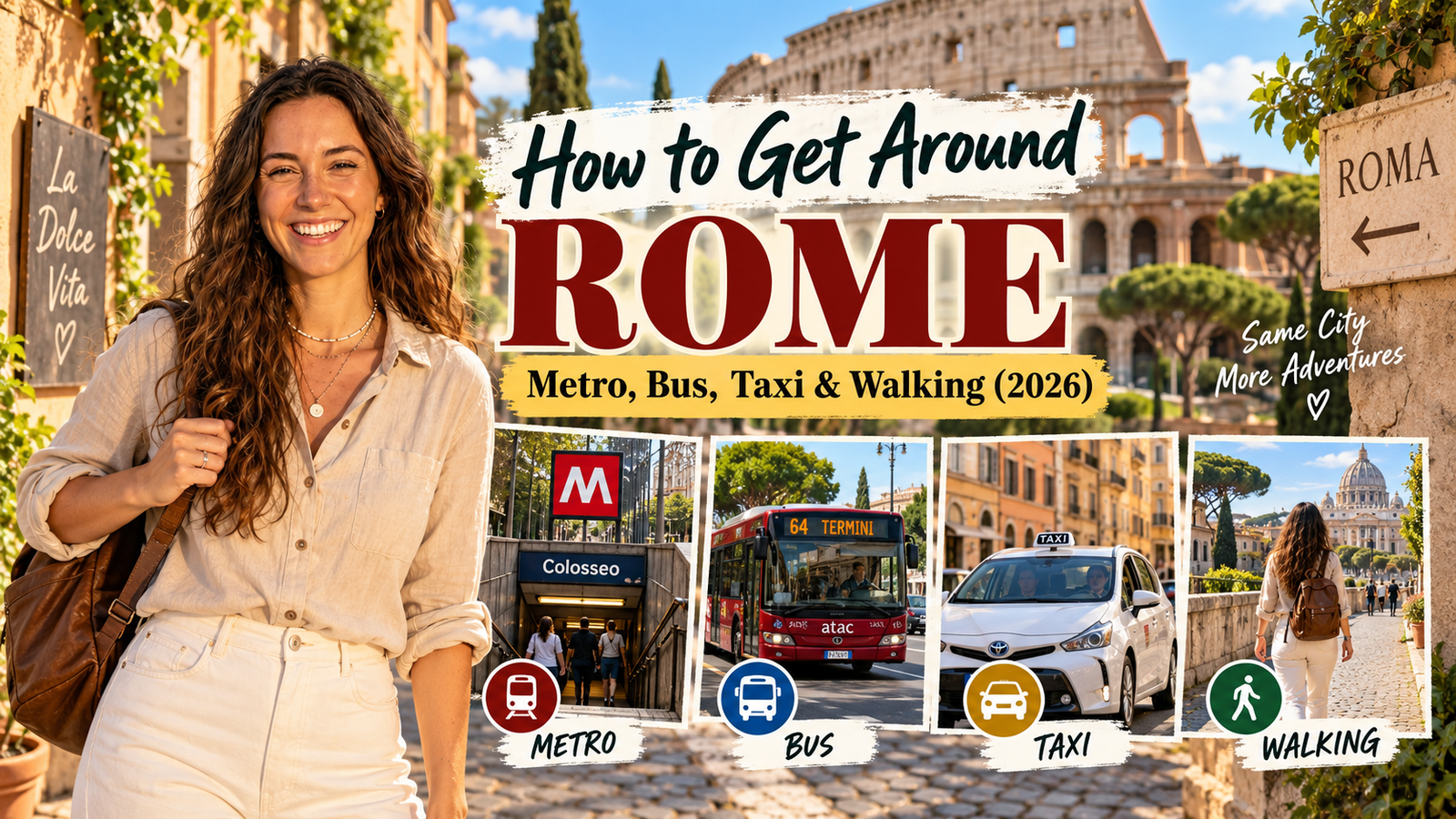
I’m Ava, a travel blogger at Smart Travel Route, and when I first planned a short trip to Rome, transportation looked more complicated than it actually was. The map showed metro lines, hundreds of bus routes, trams, regional trains, taxi ranks and streets that seemed to twist in every direction.
My first instinct was to plan a vehicle for every journey. Once I began moving around Rome, I realized that was the wrong approach. Rome works best when you treat walking as your main sightseeing transport, use the Metro for longer cross-city jumps, and bring in buses or taxis only when they genuinely improve the day.
That strategy is especially useful if you have only 4 days in Rome. You do not want to spend your holiday changing buses simply because a route planner says you can. You want a simple Rome itinerary 4 days plan that groups nearby attractions together and uses transport to connect those groups.
⭐ Ava’s Quick Rome Transport Recommendation
Best overall: Walk + Metro.
Best payment method for many visitors: Tap & Go with your own contactless card/device, or buy the pass that matches your travel pattern.
Best for Vatican City: Metro A to Ottaviano–S. Pietro–Musei Vaticani or Cipro, then walk.
Best for Colosseum: Metro B or Metro C to Colosseo/Fori Imperiali.
Best for Trevi–Pantheon–Navona: Mostly walk.
Best taxi use: Airport/luggage, late evening, reduced mobility or when your feet are finished.
How to Get Around Rome: Metro, Bus, Taxi & Walking Compared
There is no single “best” way to travel around Rome. The right choice depends on where you are staying, how far you are going, the weather, your mobility and whether your day is built around timed tickets.
| Transport | Best For | Main Advantage | Main Limitation | Typical Cost | My Verdict |
|---|---|---|---|---|---|
| Walking | Historic center | You see Rome between attractions | Heat, cobblestones, fatigue | Free | Use most often |
| Metro | Vatican, Colosseum, longer jumps | Fast and simple | Does not cover every historic-center sight | BIT €1.50 | Best public-transport option |
| Bus / Tram | Areas without convenient Metro | Huge coverage | Traffic and temporary diversions | BIT €1.50 | Useful backup |
| Taxi | Luggage, late nights, mobility needs | Door-to-door | Traffic + higher cost | Metered; fixed fees may apply | Use strategically |
| Hop-on Hop-off / Tour Transport | Easy orientation | Transport + commentary | Traffic and fixed stops | Varies | Optional |
Compare Rome Tours & Transport Options
See Times and Tour Options

How to Get Around Rome Cheaply: 2026 Tickets & Passes
Rome’s local transport tickets cover buses, trams, trolleybuses and Metro services within the urban validity rules. The main tourist choices are simple.
| Ticket | 2026 Price | Validity | Best For |
|---|---|---|---|
| BIT | €1.50 | 100 minutes; Metro subject to single-journey rules | Visitors who mostly walk |
| ROMA24H | €8.50 | 24 hours from first validation | Transport-heavy day |
| ROMA48H | €15 | 48 hours from first validation | Two busy days |
| ROMA72H | €22 | 72 hours from first validation | Three frequent-transport days |
| CIS Weekly | €29 | Until midnight of the seventh day including validation day | Unlimited travel for a 4-day trip |
For a typical first-time visitor staying centrally, BIT tickets or Tap & Go can be cheaper than automatically buying an unlimited pass. If you take only two rides per day for four days, eight BIT fares total €12. If you expect to travel constantly, the €29 CIS can be easier and cheaper than combining a €22 ROMA72H with another €8.50 24-hour ticket.
Tap & Go: easiest for many first-time visitors
ATAC’s Tap & Go system accepts supported contactless bank cards and payment-enabled devices across the Metro and ATAC surface network. Tap as required each time you change transport; taps made during the valid period do not automatically create another fare.
The system also has a best-fare feature. When your use exceeds the relevant number of BIT purchases within 24 hours, it can apply the €8.50 24-hour fare instead. The important rule is that you must keep using the same physical card or the same device used for the first tap.
Each traveler needs their own payment method for Tap & Go. ATAC states that one card/device cannot be used to pay for another person traveling with you.
Check current fares at the official ATAC tickets and passes page.
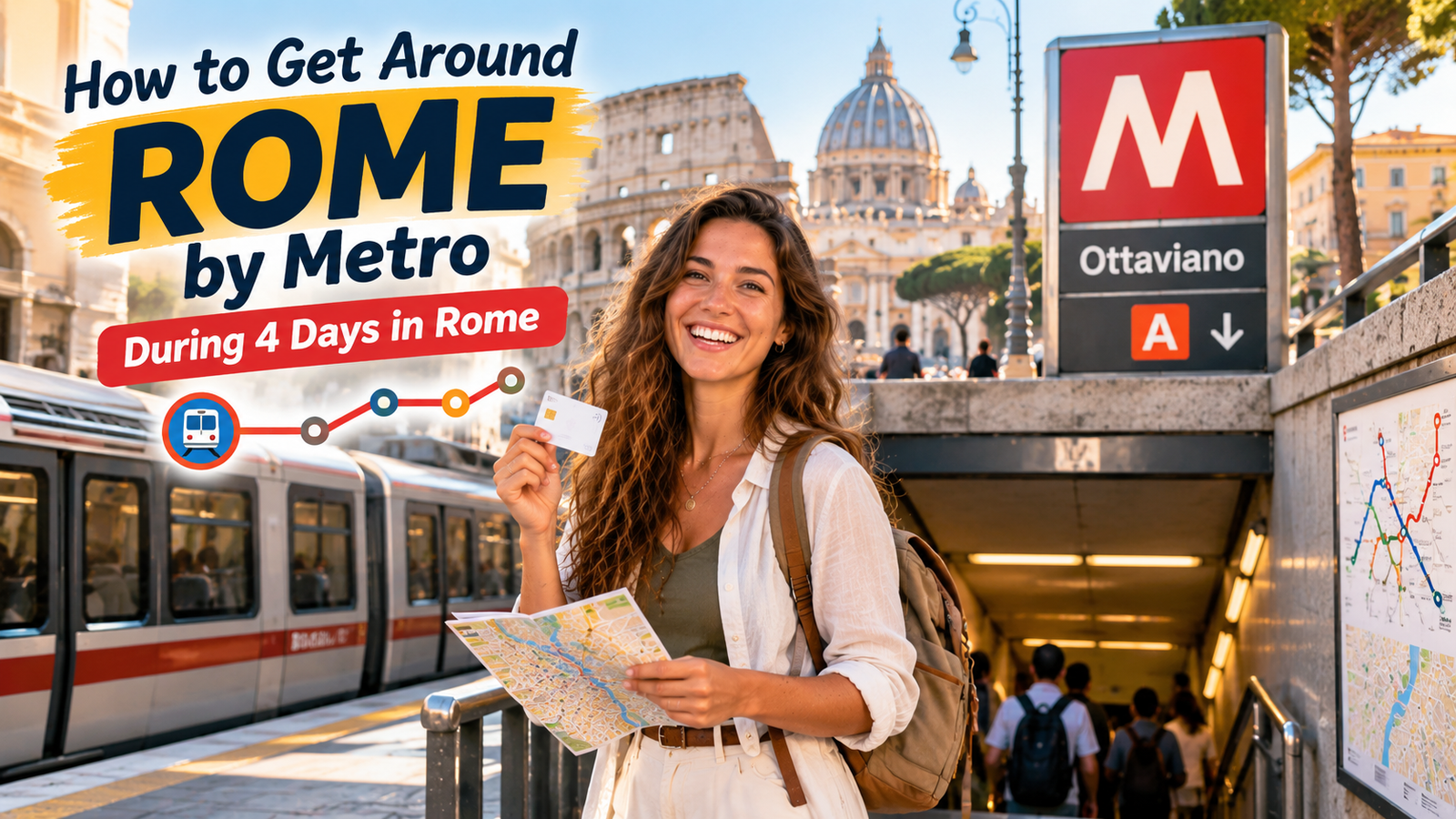
How to Get Around Rome by Metro
The Metro is the easiest public-transport system for most visitors to understand. Rome currently has Metro A, B/B1 and C, and an important update for current travel planning is that Metro C now reaches Colosseo/Fori Imperiali and connects with Metro B at Colosseo.
| Line | Useful Stops | Use It For |
|---|---|---|
| Metro A | Ottaviano, Cipro, Flaminio, Spagna, Barberini, Termini, San Giovanni | Vatican, Spanish Steps, central/northern Rome |
| Metro B/B1 | Termini, Cavour, Colosseo, Circo Massimo, Piramide | Colosseum, Ancient Rome, Circus Maximus |
| Metro C | Colosseo/Fori Imperiali, Porta Metronia, San Giovanni and eastern Rome | Colosseum connection + east Rome |
How I use Metro A for a Vatican day
For a Vatican Museums, Sistine Chapel and St. Peter’s day, I would ride Metro A to Ottaviano–S. Pietro–Musei Vaticani or Cipro depending on the exact route, then walk. After the museum, lunch and St. Peter’s, I stay on foot around Vatican City, Prati and Borgo rather than repeatedly getting back on transport.
That keeps the day simple and works well inside a larger 4 day itinerary rome italy.
How I use Metro B/C for Ancient Rome
For the Colosseum, take Metro B or Metro C to the Colosseo area. Once you arrive, stay on foot for the Colosseum, Roman Forum, Palatine Hill, Via dei Fori Imperiali and Monti. One Metro ride should get you into the sightseeing zone; walking should do most of the rest.
Normal Metro service can change because of engineering work, special events and temporary closures. I always check the official ATAC website or ATAC Roma app on the day.
How to Get Around Rome by Bus & Tram
Buses fill the gaps the Metro leaves behind. They are especially helpful when your hotel or destination is far from a station, but I would not build a first-time itinerary around several bus changes. Rome traffic, demonstrations, major events and roadworks can redirect surface routes.
That does not make buses bad. It means I use them differently. I use the Metro when there is a clear station-to-station route, and I use a bus when it saves a long walk or reaches an area the Metro does not serve conveniently.
When I Choose a Bus
Good reason #1: My hotel is not close to a Metro station.
Good reason #2: I have already walked several hours and a direct bus saves my legs.
Good reason #3: I am visiting a neighborhood where buses are more practical.
Bad reason: A route planner shows three bus changes that save only a few minutes over walking.
Check live diversions at Roma Mobilità. The official ATAC Roma app also includes journey planning, arrival predictions, digital tickets, service updates and accessibility information.

How to Get Around Rome on Foot
Walking is not just a way to move between attractions in Rome. It is part of the sightseeing. The historic center makes this obvious: Trevi Fountain, the Pantheon, Piazza Navona, Campo de’ Fiori, the Spanish Steps and many smaller churches, fountains and lanes are often better experienced as one continuous walk than as separate transport trips.
When I first mapped Rome, I treated every famous place as a separate destination. Once I began planning by neighborhoods, the trip made more sense. Instead of “go to Trevi, find transport, then go to Pantheon,” I think in clusters: Trevi → Pantheon → Piazza Navona → Campo de’ Fiori.
Best Areas to Walk
Historic center, Monti, Trastevere, Prati/Borgo, Piazza Venezia–Roman Forum area and the riverside around Castel Sant’Angelo.
Walking Challenges
Cobblestones, uneven paving, summer heat, busy crossings and the fact that a 20-minute walk feels different after eight hours of sightseeing.
Wear shoes you have already tested. A good four days in Rome itinerary can involve a lot of walking even when you use public transport daily.

How to Get Around Rome by Taxi
I do not recommend taxis for every sightseeing trip. In central Rome, traffic can make a taxi slower than walking. But taxis are extremely useful in the right situation: heavy luggage, an early departure, young children, reduced mobility, bad weather, a late evening far from the hotel or simply no energy left after a long Vatican or Ancient Rome day.
Rome’s official taxi fares use a meter for ordinary city trips. The currently published starting fee is €3.50 on weekdays from 6:00 AM to 10:00 PM, €5 on Saturdays, Sundays and public holidays during those hours, and €7.50 at night. The official minimum fare is €9 per ride, with additional rules and supplements depending on the trip.
For booking an official taxi, Roma Capitale’s ChiamaTaxi 060609 service can connect you to nearby taxis. You can also use official taxi ranks around major transport hubs and central areas.
Taxi Safety & Cost Checklist
Use a licensed white Rome taxi, check the meter when a fixed tariff does not apply, confirm airport fixed-fare eligibility before leaving, and request a receipt if needed. For current tariffs, check official Rome mobility information rather than old blog screenshots.
Official taxi tariffs are published by Roma Servizi per la Mobilità.

How to Get Around Rome for 4 Days: My Day-by-Day Transport Plan
This is the transport rhythm I recommend for a first-time Rome 4 day itinerary: use transport to reach a zone, then walk inside that zone.
| Day | Main Area | Best Transport | Walk Once You Arrive | Taxi? |
|---|---|---|---|---|
| Day 1 | Colosseum + Ancient Rome + Monti | Metro B/C to Colosseo | Colosseum → Forum → Monti | Only if tired |
| Day 2 | Vatican Museums + Sistine Chapel + St. Peter’s | Metro A to Ottaviano/Cipro | Museums → Prati/Borgo → St. Peter’s → Castel Sant’Angelo | Useful after a long day |
| Day 3 | Trevi + Pantheon + Navona | Walk; Metro A if needed to start | Almost the entire day | Rarely |
| Day 4 | Trastevere / Villa Borghese / flexible Rome | Walk + bus/Metro | Explore slowly | Useful for departure |
Day 1: Colosseum and Ancient Rome
Ride to Colosseo, then stop thinking about public transport for a few hours. The Roman Forum, Palatine area, Via dei Fori Imperiali and Monti work as one sightseeing cluster.
Day 2: Vatican Museums, Sistine Chapel & St. Peter’s
Use Metro A for the morning. Once you reach the Vatican area, walk. The Museums entrance and St. Peter’s Square are not the same entrance, so leave realistic walking and security time. For ticket planning, read my Vatican skip-the-line tickets guide.
Check Current Rome Attraction Availability
Find Last-Minute Tour Options
Day 3: Trevi, Pantheon and Piazza Navona
This is my walking day. Depending on the hotel, I may use Metro A to reach the general area, but once sightseeing begins I walk between the central landmarks.
Day 4: Keep transport flexible
After three major sightseeing days, I leave the last day flexible. Villa Borghese can work well from Flaminio/Spagna. Trastevere is better handled with walking plus the most practical live bus/tram option for your hotel. If your last day ends with a train or flight, this is when a taxi can be worth the extra cost.
For the full sightseeing sequence, use my complete 4-day Rome itinerary.

How to Get Around Rome From the Airport
Your airport transfer is different from normal city transport, especially at Fiumicino. Do not assume your €1.50 city ticket covers every airport train or special bus.
Fiumicino Airport (FCO)
For a hotel inside the Aurelian Walls, Rome’s current official taxi tariff lists a fixed €55 fare per vehicle from Fiumicino, including applicable supplements for that fixed route. Official information estimates roughly 40–50 minutes, although traffic can change that.
For public transport, compare the Leonardo Express to Termini, regional rail options and buses based on your hotel location. A train to Termini is ideal when your hotel is around Termini; it is less ideal if you then need multiple connections with large luggage.
Ciampino Airport (CIA)
Rome’s official taxi information lists a €40 fixed fare per vehicle between Ciampino Airport and addresses inside the Aurelian Walls when the fixed-fare conditions apply. ATAC urban tickets can also be used on bus lines 520 and 720 connecting Rome with Ciampino Airport.
For a detailed comparison, read my Rome airport to city center guide.
Check Rome Airport Transfer Availability
Compare Flights to Rome
Where to Stay in Rome to Spend Less Time on Transport
A central hotel can save more than taxi money. It saves sightseeing time.
| Area | Best For | Transport Advantage | Trade-Off |
|---|---|---|---|
| Centro Storico | First-time sightseeing | Walk to many sights | Higher prices |
| Monti | Ancient Rome | Near Colosseum + Metro | Slopes/cobbles |
| Prati | Vatican-focused trip | Metro A + Vatican walkability | More travel to Ancient Rome |
| Termini | Transport convenience | Metro A/B + rail hub | Less romantic atmosphere |
For more detail, read my where to stay in Rome for first-time visitors guide.
Accessibility: How to Get Around Rome With Reduced Mobility
Rome’s historic streets can be difficult because of cobbles, curbs, slopes and crowds, so accessibility is not only about whether a Metro station has an elevator.
ATAC currently reports that its bus fleet is equipped with boarding platforms and wheelchair areas. It also publishes station-by-station Metro accessibility. Most Metro stations are listed as accessible for reduced mobility, but several Metro A stops—including Spagna, Barberini, Repubblica and Vittorio Emanuele—are specifically identified as lacking lifts or stair lifts connecting with platforms.
If accessibility is essential, check the exact station and live lift status before leaving the hotel. Use ATAC’s official transport accessibility page.
Best Time to Use Metro, Bus, Taxi & Walking
Early attraction entry: Metro or taxi is usually simpler than a multi-change bus route. Historic-center sightseeing: walking is usually best. Summer afternoon: use Metro/bus for longer jumps to reduce heat exposure. Late dinner return: use Metro if still running, otherwise a practical bus or taxi. Airport with luggage: choose the route with the fewest transfers, not automatically the cheapest fare.
Transportation, Meeting Points & Tour Bookings
If you book a guided Rome experience, do not assume the meeting point is the nearest Metro exit or attraction entrance. Operators may meet at a nearby office, piazza, café, monument or designated check-in point.
The night before a timed tour, I save the meeting point in my map, screenshot the voucher and calculate a route that arrives 15–20 minutes early unless the operator gives a different check-in time. I avoid planning several bus changes for a reservation I cannot afford to miss.
Cancellation Considerations for Rome Transport & Tours
City transport and prebooked travel products need different thinking. For public transport, the practical issue is timing: ROMA24H, 48H and 72H tickets begin their validity from first validation, so I wait until I actually need the pass.
For airport transfers, hop-on hop-off products and guided experiences, check the individual cancellation deadline before paying. A GetYourGuide listing may offer free cancellation or a refundable option, but exact terms vary by product.
Reserve a Refundable Rome Option
Important Mistakes to Avoid When Getting Around Rome
If you mostly walk, individual €1.50 rides can cost much less.
Validity starts from first validation.
Keep using the same payment method you started with.
ATAC says the service is individual.
Traffic and diversions can make surface travel less predictable.
In traffic, walking can be faster and free.
Airport trains, special buses and fixed taxi routes have separate rules.
Works, demonstrations and events can close stations or divert buses.
Protect your feet for the rest of the trip.
A poor location can cost time and transport every day.
FAQs: How to Get Around Rome
What is the best way to get around Rome?
For most first-time visitors, walking plus the Metro is the best combination. Use buses for gaps and taxis when luggage, weather, mobility or late-night travel makes door-to-door transport worth the cost.
Is Rome easy to get around without a car?
Yes. A rental car is unnecessary for a normal central sightseeing trip. Main tourist areas are walkable and connected by Metro, buses, trams and taxis.
How much is a Rome Metro ticket in 2026?
The standard BIT ticket is currently €1.50 and is valid for 100 minutes under ATAC rules, with Metro use subject to its single-journey conditions.
Is the 72-hour Rome pass worth it?
It can be if you expect frequent public-transport use for three consecutive days. If you stay centrally and mostly walk, individual fares may be cheaper.
What transport pass is best for 4 days in Rome?
There is no automatic winner. The €29 CIS gives unlimited local travel across a longer period, while a visitor making only a few rides can spend far less with BIT tickets or Tap & Go.
Can I use my bank card on the Rome Metro?
Yes, supported contactless cards and payment-enabled devices can use ATAC Tap & Go. Keep using the same card/device for your journey and best-fare calculation.
Can one card pay for two people?
Not with ATAC Tap & Go. It is an individual service, so each person needs their own payment method.
Which Metro station is best for the Vatican?
Ottaviano–S. Pietro–Musei Vaticani on Metro A is convenient for many visitors; Cipro can also work well for the Museums depending on your route.
Which Metro station is best for the Colosseum?
Colosseo/Fori Imperiali is the obvious stop. The area now connects Metro B and Metro C.
Is Rome walkable?
Very much so in central sightseeing areas. The historic center is best explored on foot, but use public transport before heat or fatigue damages the rest of your day.
How much is a taxi from Fiumicino to central Rome?
The current official fixed fare to destinations inside the Aurelian Walls is €55 per vehicle when fixed-fare conditions apply.
How much is a taxi from Ciampino to central Rome?
The current official fixed fare is €40 per vehicle to destinations inside the Aurelian Walls when fixed-fare conditions apply.
Read More Rome & Travel Guides
Complete 4-Day Rome Itinerary
Vatican Skip-the-Line Tickets Guide
Where to Stay in Rome for First-Time Visitors
Rome Airport to City Center
Best Luggage Sets for Travel
Budget Travel Guide
Budget Travel Tips Thailand
Eiffel Tower Summit Tickets
My Final Advice on How to Get Around Rome
For a first trip, I would not spend hours memorizing Rome’s bus network. I would choose a well-located hotel, group each sightseeing day by area, learn the few Metro stations that matter to my itinerary, and keep the official ATAC app on my phone for everything else.
That turns transportation from a planning problem into a simple rhythm: Metro to the neighborhood → walk between attractions → bus or taxi only when it improves the day.
If you are planning four days in Rome, this approach protects your energy. Day 1 can be Ancient Rome, Day 2 Vatican City, Day 3 the historic center, and Day 4 a flexible neighborhood day. You spend less time crossing the city and more time experiencing it.
Ready to Plan Your Rome Trip?
Book the parts that genuinely need reservations, then keep local transport flexible.
About the Author
Ava is a travel blogger at Smart Travel Route who creates practical itineraries for first-time visitors. Her guides focus on realistic sightseeing routes, transportation, accommodation strategy and booking tips designed to make short European trips easier to plan.
Affiliate Disclosure: Smart Travel Route contains affiliate links to GetYourGuide, hotel booking platforms and flight comparison sites. I may earn a small commission at no extra cost to you when you book through these links.